Why Nashville Homeowners Are Cutting Down Their Bradford Pear Trees
If you live in Nashville, there’s a good chance you have a Bradford pear tree in your yard. Or two. Or a whole row of them lining the street. They were the default landscaping tree in Middle Tennessee for decades, fast-growing, cheap at the nursery, and covered in white flowers every March.
Now Tennessee wants them gone.
The state has officially recognized Bradford pears as an invasive species, and there’s an active bounty program encouraging homeowners to remove them and plant native trees instead. Nashville neighborhoods from Belle Meade to Hermitage to Antioch are pulling out Bradford pears by the hundreds.
We’ve been removing Bradford pear trees across Nashville for 35 years, and honestly, this is long overdue. Here’s why these trees are a problem, what the state program offers, how Bradford pear removal works, and what to plant instead.
What’s Wrong With Bradford Pear Trees?
Bradford pears looked like a perfect tree on paper. They grow fast, tolerate poor soil, produce no edible fruit, and have that dramatic spring bloom. Nurseries across Tennessee sold millions of them starting in the 1960s.
The problems didn’t become obvious for a couple of decades. Now they’re impossible to ignore.
They’re Invasive, And Getting Worse
Here’s what most Nashville homeowners don’t realize: Bradford pears don’t stay Bradford pears. They’re a cultivar of Callery pear (Pyrus calleryana), and while a single Bradford pear can’t pollinate itself, it absolutely cross-pollinates with other Callery pear cultivars, Cleveland Select, Aristocrat, Chanticleer, and any of the other varieties planted across Middle Tennessee.
When that cross-pollination happens, the resulting fruit is viable. Birds eat the small fruits and spread the seeds everywhere. The offspring aren’t neat ornamental trees, they’re thorny, aggressive Callery pear seedlings that colonize roadsides, fence lines, pastures, and forest edges across Davidson County.
Drive along any highway in Nashville and you’ll see them. Those dense clusters of white-flowering trees along I-65 and I-24 every spring? Callery pear escapees. They’re choking out native species like dogwood, redbud, and serviceberry, the trees that actually belong here.
They Break Apart in Every Storm
Bradford pears have the worst branch structure of any common landscape tree in Nashville. The branches grow at extremely tight, narrow angles from the trunk, which creates weak attachment points. Every branch is essentially a split waiting to happen.
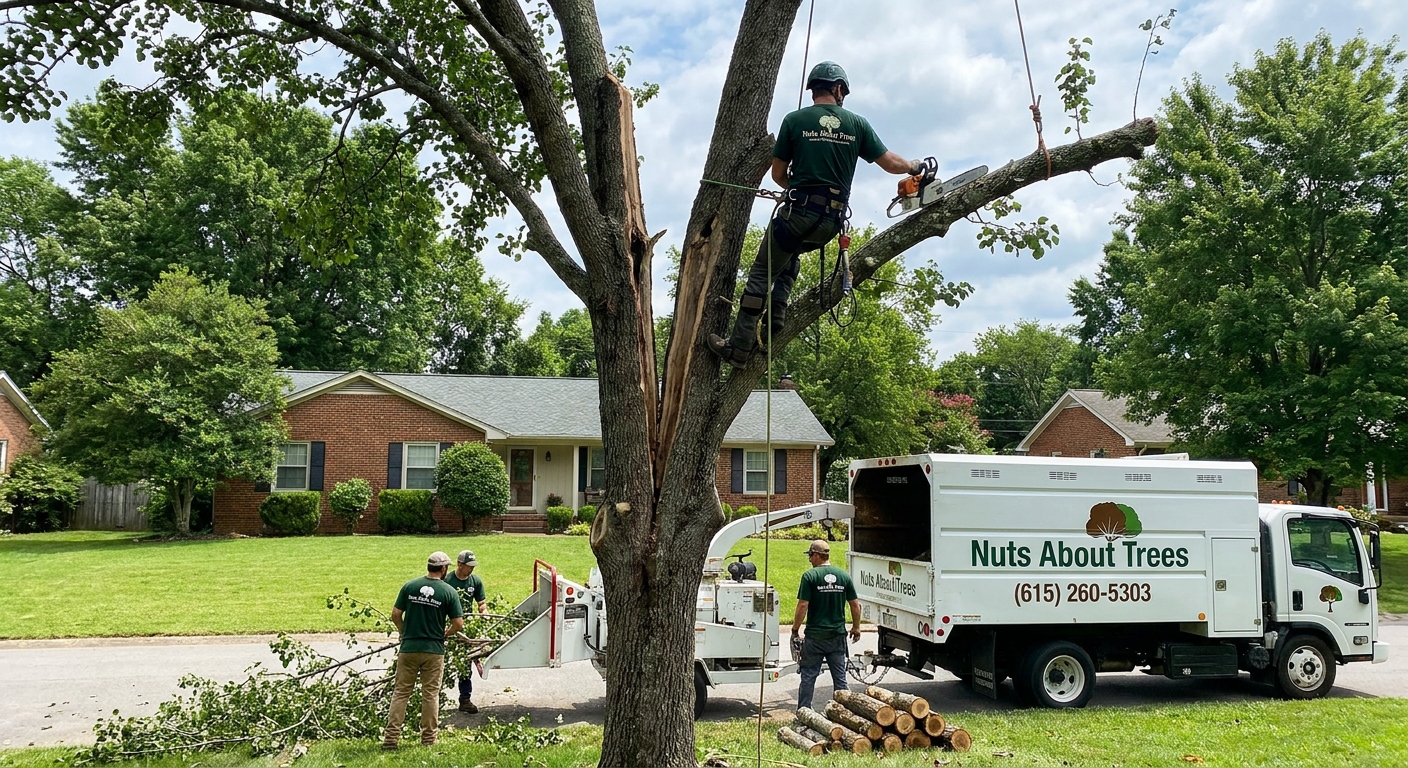
In 35 years of tree service in Nashville, we’ve seen Bradford pears fail in every type of weather event, ice storms in January, spring thunderstorms in April, straight-line winds in summer. It doesn’t take much. A quarter-inch of ice will split a mature Bradford pear right down the middle.
We get more emergency calls for Bradford pear failures than any other species. They split onto roofs, cars, fences, and power lines. The structural weakness is genetic, no amount of pruning fixes it.
They Smell Terrible
Let’s be honest about this one. Those pretty white flowers? They smell like rotting fish. Nashville homeowners who planted Bradford pears near patios, bedroom windows, or front porches know exactly what we’re talking about. Two weeks every spring, you can’t open the windows.
The trimethylamine compounds in the flowers attract pollinators, but they also make outdoor living miserable during bloom season. It’s a minor issue compared to the invasiveness and structural failure, but it’s worth mentioning.
Tennessee’s Bradford Pear Bounty Program
Tennessee has taken this seriously. The state’s Bradford Pear Bounty Program, run through the Tennessee Department of Agriculture and various local conservation districts, offers homeowners free native replacement trees when they remove a Bradford pear.
Here’s how it typically works:
- You commit to removing at least one Bradford pear tree from your property
- You register through the program (usually during annual sign-up periods, often in late winter or early spring)
- You receive a free native tree seedling, usually a 3-5 foot starter tree, in exchange for proof of removal
- Species offered include dogwood, redbud, serviceberry, and other Tennessee natives
The program has been growing every year. Nashville-Davidson County participation has been strong, and the Tennessee Division of Forestry actively promotes it. Check with the Davidson County Soil and Water Conservation District for current registration dates, they usually open in January or February for spring exchanges.
Important note: The bounty program gives you a free replacement tree, but it doesn’t cover the cost of removing the Bradford pear. That’s on you. But the removal cost is a one-time expense that eliminates an ongoing problem, and it’s less than most people expect.
Bradford Pear Removal Cost in Nashville
Bradford pear removal is one of the more affordable tree removals because they don’t get as big as oaks or tulip poplars. Most Bradford pears in Nashville yards are 25-40 feet tall with trunk diameters of 12-20 inches.
Here’s what Bradford pear removal typically costs in Nashville:
- Small Bradford pear (under 25 feet): $300-$800
- Medium Bradford pear (25-35 feet): $800-$1, 500
- Large Bradford pear (35-45 feet): $1, 500-$2, 500
- Storm-damaged Bradford pear (split trunk): $500-$2, 000 depending on where it fell
If you have multiple Bradford pears, and many Nashville properties have 2-4, most companies offer a per-tree discount when removing them all in one visit. We regularly do multi-tree Bradford pear removals in neighborhoods like Donelson, Madison, and Bellevue where they were planted heavily in the 1980s and 1990s.
Stump grinding adds $100-$300 per stump and is worth doing at the same time. You don’t want Bradford pear root suckers popping up across your yard for the next three years.
How Bradford Pear Removal Works
The good news about Bradford pears: they’re relatively straightforward to remove compared to a 70-foot white oak or tulip poplar. Here’s what our crew does on a typical Bradford pear removal in Nashville.
Assessment and setup. We walk the property, check the tree’s lean and any existing splits, identify power lines or structures in the drop zone, and set up our equipment. Bradford pears near houses usually require rigging to control the descent of larger limbs.
Crown reduction. We take the canopy down in sections, starting from the top. With Bradford pears, we’re especially careful because the tight branch unions mean pieces can split unpredictably. Our arborist crew knows where to make cuts that control each section’s fall.
Trunk takedown. Once the canopy is gone, we take the trunk down in manageable sections. Bradford pear wood is dense and heavy for its size, a 15-inch trunk section can surprise you with its weight.
Cleanup and stump grinding. We chip all branches, haul everything off-site, and grind the stump below grade. The whole process usually takes 2-4 hours for a single tree. Multiple trees on the same property go faster because the equipment is already set up.
Why Pruning Won’t Save a Bradford Pear
Some homeowners ask if they can just prune the Bradford pear to make it safer. We understand the thinking, the tree is mature, it provides shade, and removal feels drastic.
But here’s the reality: the structural problem is built into the tree’s DNA. Bradford pears grow with a central leader and tightly spaced scaffold branches that all attach at narrow angles. You can thin the crown to reduce wind load, and that might buy you a year or two. But every branch union is still a weak point.
We’ve pruned thousands of Bradford pears over the years, and the honest answer is that pruning delays failure without preventing it. Every heavily pruned Bradford pear we’ve worked on eventually split anyway, usually during the next ice storm. The $300-$500 you’d spend on pruning every 2-3 years is better invested in removing the tree once and planting something that will actually last.
What to Plant Instead: Native Replacements for Nashville
This is the best part of removing a Bradford pear, you get to plant something better. Nashville has outstanding native tree options that provide the same spring flowers, fall color, and shade without the invasiveness or structural weakness.
Serviceberry (Amelanchier)
If you loved the spring blooms on your Bradford pear, serviceberry is the answer. White flowers in early spring, edible berries that attract birds, beautiful fall color, and a graceful form that tops out at 15-25 feet. It’s native to Tennessee, wildlife-friendly, and has never split in half in anyone’s driveway. Thrives in Nashville’s clay soil.
Flowering Dogwood (Cornus florida)
Tennessee’s state tree and an obvious choice. Dogwoods bloom slightly later than Bradford pears, usually late March to early April in Nashville, with those iconic white or pink bracts. They max out around 20-30 feet, which is a better fit for most residential lots. Plant them in partial shade for best results in our climate.
Eastern Redbud (Cercis canadensis)
Redbuds bloom even earlier than Bradford pears, covering bare branches with magenta-pink flowers in late February to early March. They’re native throughout Middle Tennessee, grow 20-30 feet tall, and have a beautiful spreading form. They’re also one of the first food sources for early pollinators. We see gorgeous mature redbuds in East Nashville and Sylvan Park yards.
Blackgum (Nyssa sylvatica)
If you want a shade tree rather than a flowering ornamental, blackgum is hard to beat. It’s native, long-lived (200+ years), resistant to pests and diseases, and has the best fall color of any tree in Nashville, deep scarlet red that looks like it’s on fire. Grows 30-50 feet tall with a pyramidal form. It’s also one of the few native trees that tolerates both wet and dry conditions in Davidson County’s unpredictable soil.
Other Strong Options
- Yellowwood (Cladrastis kentukea): Stunning white flower clusters in late spring, smooth bark, native to Tennessee limestone. A showstopper at 30-50 feet.
- American Fringe Tree (Chionanthus virginicus): Fragrant white blooms in April-May, compact size (12-20 feet). Great for smaller yards in neighborhoods like Green Hills or Inglewood.
- Tulip Poplar (Liriodendron tulipifera): Tennessee’s state tree, fast-growing, tulip-shaped flowers, reaches 60-80 feet. Only plant this if you have the space.
Our arborist team can help you choose the right replacement based on your yard size, sun exposure, soil conditions, and what you’re looking for. A free consultation is part of the process when we remove a Bradford pear.
Nashville Neighborhoods Where We Remove the Most Bradford Pears
Bradford pear planting peaked in Nashville during the 1980s and 1990s, which means certain neighborhoods have more of them than others. Here’s where we do the most Bradford pear removals:
Donelson and Hermitage. Subdivisions built in the 1970s-1990s planted Bradford pears heavily as street and yard trees. Many are now 30-40 years old and reaching the end of their structural lifespan. We’ve done entire streets in Hermitage where neighbors coordinated removals.
Madison and Inglewood. Similar era of development with Bradford pears in front yards and along property lines. The clay soil in Madison seems to make the lean and split problems even worse.
Bellevue and Sylvan Park. Mixed residential areas where Bradford pears were popular in both commercial and residential plantings. Some of the worst splits we’ve seen came from large Bradford pears in Bellevue during the January 2024 ice event.
Antioch and Brentwood. Antioch developments from the 1980s and 1990s have aging Bradford pears throughout. Brentwood’s larger properties often have multiple Bradford pears that were planted as ornamental accents.
If your subdivision was built between 1975 and 2005, check your landscape trees. There’s a good chance at least some of them are Bradford pears, or one of the other Callery pear cultivars that cause the same problems.
Do I Need a Permit to Remove a Bradford Pear in Nashville?
Nashville-Davidson County’s tree ordinances apply to the removal of certain trees on residential and commercial lots, but the rules vary based on your property’s zoning and whether you’re in an urban overlay district.
For most residential properties:
- Trees under 12 inches in diameter can typically be removed without a permit
- Trees over 12 inches may require a permit depending on your zoning classification
- Properties in urban overlay districts have additional tree protection requirements
- Bradford pears are increasingly being exempted from permit requirements due to their invasive status, check with Metro Nashville Codes for current rules
We handle permit questions for every removal job. When you call us for a Bradford pear estimate, we’ll check your property’s zoning and let you know if any permits are needed before we start work.
The Environmental Case for Bradford Pear Removal
Removing a healthy-looking tree feels counterintuitive if you care about the environment. But Bradford pears are one of those rare cases where cutting down a tree is the ecologically responsible thing to do.
Every mature Bradford pear in your Nashville yard contributes to the spread of invasive Callery pears throughout Middle Tennessee. The cross-pollinated fruit that birds spread is colonizing natural areas, forest edges, and riparian zones across Davidson County and beyond.
Invasive Callery pears displace native understory trees that Tennessee wildlife depends on, dogwood berries feed 40+ bird species, serviceberry feeds wildlife and pollinators, and native oaks support hundreds of caterpillar species that are essential food for nesting birds.
Replacing one Bradford pear with a native tree is a net positive for Nashville’s urban ecosystem. Replacing a whole yard of them makes a meaningful difference. When Nashville homeowners ask us whether it’s worth the cost, we always say yes, both for the property and for the environment.
Frequently Asked Questions
How long do Bradford pear trees live in Nashville?
Most Bradford pears in Nashville last 20-30 years before they either split apart or decline. That’s short compared to native trees like white oak (200+ years) or dogwood (80+ years). Many Bradford pears planted in the 1980s and 1990s are already past their functional lifespan.
Can I remove a Bradford pear myself?
For very small trees (under 15 feet), DIY removal is possible if you’re comfortable with a chainsaw and understand basic felling technique. For anything larger, especially trees near houses, fences, or power lines, professional tree removal is the safe choice. Bradford pears split unpredictably, which makes them more dangerous to fell than you’d expect for their size.
When is the best time to remove a Bradford pear?
Any time of year works. Winter is ideal because the tree is dormant, the ground is firmer, and there’s less impact on surrounding plants. But don’t wait for the “right” season if your tree is showing splits or heavy lean, call sooner rather than later.
Will the roots grow back after removal?
Bradford pear roots can send up sprouts (suckers) after the trunk is removed. Stump grinding below grade significantly reduces this, but you may need to pull a few root suckers for a year or two. Treating the stump with an herbicide at the time of grinding eliminates regrowth entirely.
Is Bradford pear wood good for firewood?
Yes, actually. Bradford pear is a dense hardwood that burns well once seasoned for 6-12 months. It produces good heat with relatively low smoke. If you have a fireplace or fire pit, it’s worth keeping the trunk wood. We can section it for you during removal.
How many Bradford pears are in Nashville?
There’s no exact count, but estimates suggest hundreds of thousands across Davidson County alone. They were the top-selling ornamental tree in Tennessee nurseries for over 30 years. Nashville’s urban canopy inventory includes significant Bradford and Callery pear populations in virtually every neighborhood.
Get Your Bradford Pear Removed
Whether you’re participating in the state bounty program or just tired of watching your Bradford pear split after every storm, removal is straightforward and more affordable than most homeowners expect.
We’ve been doing tree removal in Nashville for 35 years. We’ll give you a firm price, handle the job safely, grind the stump, and if you want, help you pick a native replacement that will look better, last longer, and actually belong in Tennessee.
Call New Horizon Tree Service at (615) 260-5303 for a free estimate.
See our reviews and service area on Google


