Ice Storm Tree Damage in Nashville Is More Predictable Than You Think
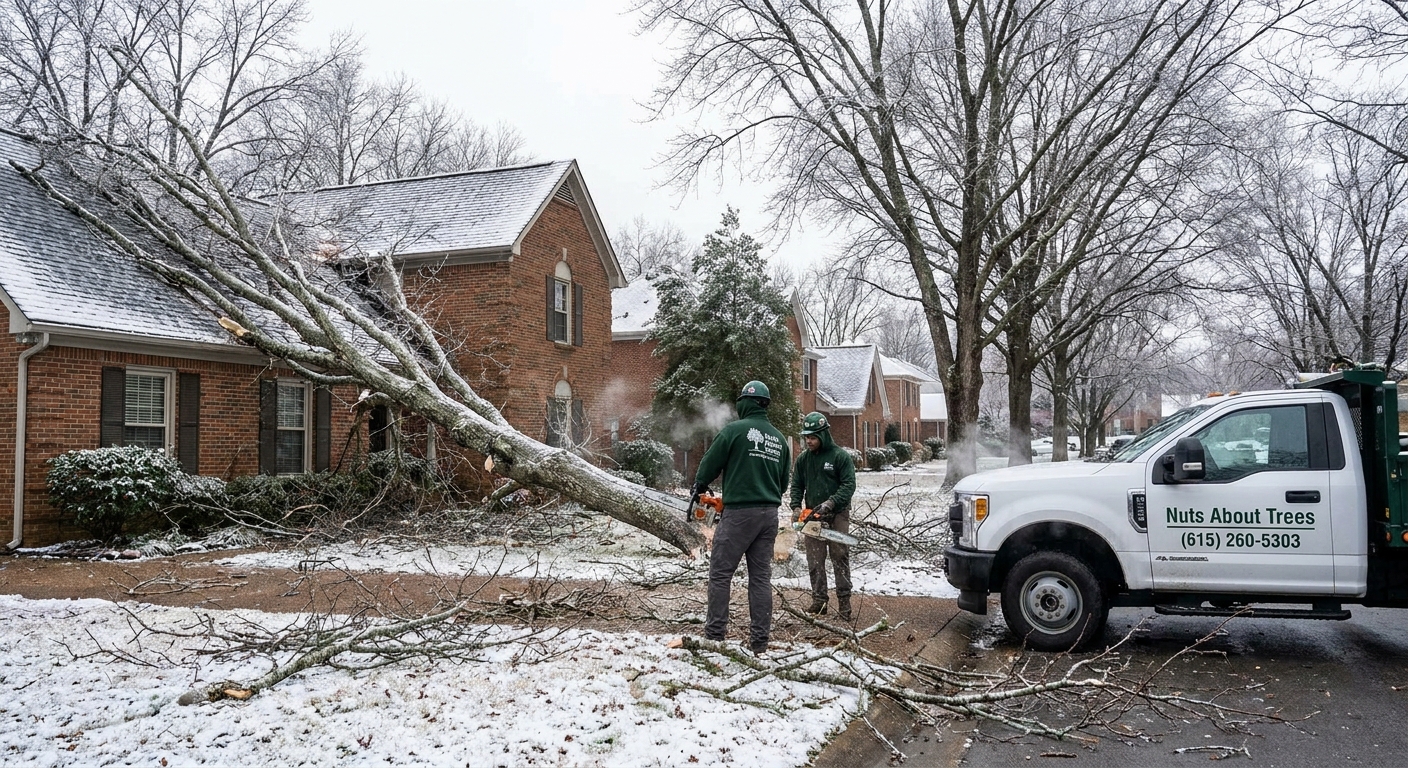
Every January and February, the same thing plays out across Nashville. The forecast calls for freezing rain, temperatures hover right around 32 degrees, and by morning every branch in your yard is coated in a quarter-inch of ice. Then you hear it, the crack of a limb giving way somewhere in the dark.
Ice storms cause more tree damage in Middle Tennessee than any other weather event. Not tornadoes, not straight-line winds, not summer drought. Ice. The weight of frozen rain on branches does damage that accumulates slowly and then happens all at once.
We’ve been responding to ice storm damage across Nashville for 35 years. After that many winters, we can tell you which trees are going to fail, which neighborhoods get hit hardest, and exactly what you should do before, during, and after an ice event to protect your property.
Here’s the guide we wish every Nashville homeowner had before the next freeze.
Why Nashville Gets Hit So Hard by Ice Storms
Nashville sits in a geographic sweet spot for ice storms, and not in a good way. The Cumberland Plateau to the east and the Highland Rim topography create conditions where warm air overruns cold surface air along the Tennessee valley. When a winter system pushes through, rain falls through that warm layer and then freezes on contact with cold surfaces, trees, power lines, roads, everything.
Middle Tennessee averages 1-3 significant ice events per winter. Some years you get nothing. Other years, like the February 2015 storm or the January 2009 ice event, Nashville gets hammered with half an inch or more of ice accumulation. That’s when the real damage happens.
A quarter-inch of ice on branches adds roughly 500 pounds of weight per tree for a mature hardwood. At half an inch, that number more than doubles. Most healthy trees can handle a light glaze. But when ice accumulates beyond a quarter-inch and stays frozen for 12-24 hours, branches start snapping.
The neighborhoods with the oldest, tallest tree canopies take the worst damage. Belle Meade, Green Hills, Sylvan Park, and East Nashville have mature trees that catch more ice because of their size and canopy spread. Newer subdivisions with younger trees tend to fare better.
Which Nashville Trees Break First in Ice Storms
Not all trees are equally vulnerable. After 35 years of cleaning up ice storm damage across Davidson County, we know exactly which species fail first.
Bradford Pear, The Worst of the Worst
Bradford pears split in every ice storm. Every single one. Their tight V-shaped branch unions are structurally weak by design. When ice loads those branches, the crotches crack and the tree splits apart like it was pulled in four directions at once. If you still have a Bradford pear on your Nashville property, it’s not a question of whether it will fail in an ice storm, it’s when. Removal before winter is the only reliable solution.
Sweetgum, Brittle Branch Junctions
Sweetgums are common across Nashville, and they’re one of the most ice-vulnerable native species. Their branches form narrow angles that trap ice and create leverage. We see more broken sweetgum limbs after ice storms than almost any other species. The good news: sweetgums usually lose branches rather than splitting entirely, so strategic pruning reduces the risk significantly.
Red Maple, Weak Wood Under Load
Red maples are planted everywhere in Nashville, along streets, in yards, around parking lots. They grow fast, which means softer wood that’s more susceptible to ice loading. Mature red maples in neighborhoods like Inglewood, Madison, and Donelson frequently drop large branches during ice events. Annual tree trimming to reduce canopy density helps these trees handle ice better.
Hackberry, Codominant Stems
Hackberries are a Nashville native that tolerates our clay soil well but develops codominant leaders, two or more main trunks competing for dominance. Where those trunks meet, the wood is weak. Ice loading puts enormous lateral force on those junctions, and hackberries with codominant stems are prone to splitting down the middle.
Tulip Poplar, Height Catches More Ice
Tennessee’s state tree grows tall and fast. An 80-foot tulip poplar collects significantly more ice than a 40-foot tree simply because of the canopy surface area. Their wood is relatively soft, and their long branches act as levers when loaded with ice. We see tulip poplars lose major limbs in nearly every significant Nashville ice event. The largest ones, common in Belle Meade and along the Harpeth River corridor, can drop branches weighing several hundred pounds.
Trees That Handle Ice Well
Not everything breaks. White oaks, Eastern red cedars, and bald cypresses are the most ice-resilient species in Nashville. White oaks have dense wood and strong branch unions. Eastern red cedars are flexible and shed ice naturally. Bald cypresses lose their needles before winter, so there’s minimal surface area to catch ice. If you’re replacing a storm-damaged tree, these species are worth considering.
Preventive Pruning: The Best Money You’ll Spend Before Winter
Here’s what most Nashville homeowners don’t realize: the vast majority of ice storm tree damage is preventable. Not all of it, a catastrophic ice event will damage even healthy, well-maintained trees. But the branch failures, split trunks, and falling limbs that cause most property damage? Those almost always happen on trees with pre-existing structural problems.
Preventive pruning done in fall or early winter, before the ice season, reduces your risk dramatically. Here’s what it involves:
Crown thinning. Removing select interior branches reduces the canopy density, which means less surface area to catch ice and less weight on every remaining branch. A properly thinned canopy lets ice and wind pass through rather than building up. We thin 15-20% of the crown, enough to reduce ice loading without stressing the tree.
Deadwood removal. Dead branches snap first in ice storms. They have no flexibility, no structural integrity, and they come down with minimal provocation. Removing all dead wood from the canopy before winter eliminates the most predictable source of falling debris.
Structural pruning. Correcting codominant stems, reducing long laterals, and addressing weak branch unions, this is the work that prevents catastrophic failures. A branch with a tight V-shaped crotch that’s been competing with its neighbor for 20 years is an ice storm failure waiting to happen. Reducing the weight on the weaker limb or removing it entirely solves the problem before the ice arrives.
For a mature tree in Nashville, preventive pruning costs $300-$800 depending on tree size and the amount of work needed. That’s a fraction of what emergency removal costs after a limb puts a hole in your roof.
The best time to schedule preventive pruning is October through December. By mid-January, ice season is already underway and you’re rolling the dice.
What to Do During an Ice Storm
When the freezing rain starts, there’s a limited amount you can do. But these steps protect you and your property:
Stay inside and away from windows facing large trees. This sounds obvious, but people underestimate how far debris can travel when a large branch breaks. A 30-foot branch falling from 50 feet up can slide, bounce, or roll well beyond where you’d expect. Park cars in the garage if possible.
Do not go outside to shake ice off branches. We see this every year. Someone goes out with a broom or pole trying to knock ice off their trees. Two problems: the falling ice and debris can injure you, and shaking an ice-loaded branch can cause it to snap at the point of highest stress, right above your head.
Listen for cracking sounds. If you hear sharp cracking or popping from your trees, that’s fibers breaking under the ice load. The tree may not fail immediately, sometimes it takes hours for a weakened branch to finally let go. If you hear cracking, move away from that side of the house and stay alert.
Stay away from downed power lines. TVA and NES lines run through tree canopies all over Nashville. When branches break, they bring lines down. Assume every downed line is live and call NES at 615-234-0000. Do not attempt to remove tree debris that’s in contact with power lines.
Document damage as it happens. Take photos and videos from inside through windows if you can see damage occurring. This documentation is valuable for insurance claims later.
After the Ice Storm: Assessing Damage Safely
Once the ice melts and it’s safe to go outside, resist the urge to start cleaning up immediately. Here’s the right approach:
Walk the property at a distance first. Look up. Look for hanging branches, split trunks, and limbs resting in the canopy that haven’t fallen yet. These “hangers” are extremely dangerous, they can fall without warning. If you see hanging debris, stay well away from the tree and call a professional.
Check for leaning trees. A tree that was vertical before the storm and is now leaning has suffered root failure. The root plate has partially pulled out of the ground. This tree could fall at any time, in any direction. Mark the area, warn family members, and call for emergency tree service.
Assess split trunks. If a main trunk has split but both halves are still standing, do not approach. A partially split trunk is under enormous internal tension. The remaining wood fibers can fail suddenly, sending the split section in an unpredictable direction. This is a job for a crew with rigging and equipment.
Small debris is your job, big stuff is ours. Branches under 4 inches in diameter that are on the ground and not near power lines are safe for you to clean up. Anything larger, anything elevated, anything near utility lines, that’s professional work.
When to Call an Emergency Tree Service vs. Wait for a Regular Appointment
After a Nashville ice storm, every tree service in town gets flooded with calls. Knowing when you actually need emergency response vs. when you can wait a few days helps both you and the crew prioritize.
Call for emergency service when:
- A tree or large branch is on your house, garage, or other occupied structure
- A tree is blocking your only way in or out of the property
- A tree is in contact with or dangerously close to power lines
- A split trunk or leaning tree threatens to fall on a structure or public area
Schedule a regular appointment when:
- Branches fell in the yard but didn’t hit anything
- A tree lost limbs but the trunk is solid and it’s not leaning
- You want an assessment of tree health after the storm
- You need cleanup of smaller debris the tree left behind
Emergency response after an ice storm costs more, typically 25-40% above standard rates, because of the urgency, after-hours work, and dangerous conditions. If your situation isn’t truly an emergency, waiting 3-5 days for a scheduled visit saves money and lets the emergency crews focus on the most critical situations.
Our storm damage team responds to true emergencies first, then works through the queue in priority order. We’ll give you an honest assessment over the phone of whether your situation is urgent or can wait.
Ice Storm Damage and Insurance: What Nashville Homeowners Need to Know
Ice storm tree damage is one of the most common, and most confusing, homeowner’s insurance claims in Nashville. Here’s how it typically works:
Tree falls on your house or other insured structure: Your homeowner’s policy generally covers the cost of removing the tree from the structure AND repairing the damage. Most policies also cover removal of the tree itself, typically up to $500-$1, 000 per tree.
Tree falls in the yard but doesn’t hit anything: Most policies do not cover removal of a fallen tree that hasn’t damaged an insured structure. The tree fell on your lawn? That’s your expense. This is the situation that surprises most Nashville homeowners.
Tree falls on your car: That’s a comprehensive auto insurance claim, not homeowner’s. Make sure your vehicles are covered.
Neighbor’s tree falls on your property: Generally, your insurance covers damage to your structures regardless of whose tree caused it. The neighbor’s policy doesn’t typically pay for damage their tree caused on your property unless you can prove negligence, meaning they knew the tree was hazardous and did nothing.
Document everything before cleanup begins. Take photos of the tree’s position, all damage, and the overall scene. Get multiple estimates for removal and repair. File the claim promptly, most policies require notification within a specific timeframe.
We provide detailed invoices that clearly separate tree removal costs from other work, which makes the insurance claim process smoother. We’ve worked with every major insurer operating in Nashville and can format our documentation to match what adjusters need.
Building Long-Term Ice Storm Resilience for Your Nashville Property
If you’re tired of worrying every time the forecast mentions freezing rain, there’s a long-term approach that significantly reduces your risk:
Annual professional inspection. Have an arborist evaluate your trees every fall, before ice season. They’ll identify structural weaknesses, dead wood, and codominant stems that put you at risk. Think of it like a physical for your trees. A Nashville tree service that knows your property year over year spots developing problems before they become emergencies.
Proactive removal of high-risk trees. If you have a Bradford pear, a structurally compromised hackberry, or a large sweetgum with multiple codominant leaders directly over your house, remove it on your schedule, not the ice storm’s schedule. Planned removal is safer, cheaper, and less stressful than emergency removal at 2 AM during a storm.
Strategic replanting. When you remove a vulnerable tree, replace it with a species that handles Nashville ice better. White oaks are the gold standard, strong wood, excellent branch structure, long-lived. Eastern red cedars work well for screening. Bald cypresses thrive in wet spots. Your arborist can recommend the right species for your specific lot conditions.
Cable and bracing for valuable trees. Some large, mature trees with structural weaknesses are worth preserving with support systems. Steel cables installed between codominant stems reduce the chance of splitting. Bracing rods through weak crotches add structural support. These systems don’t guarantee the tree survives every ice storm, but they significantly improve the odds. A cabling system runs $300-$800 and can extend the safe life of a tree by decades.
Nashville’s Ice Storm History: What the Record Tells Us
Understanding Nashville’s ice storm pattern helps you prepare. Here are the events our crew has responded to:
- January 2009: One of Nashville’s worst ice storms in recent memory. Half-inch ice accumulation across Davidson County. Thousands of trees damaged or destroyed. NES outages lasted over a week in some areas. We worked 16-hour days for three weeks straight.
- February 2015: Significant ice event with quarter- to half-inch accumulation. Heavy damage in East Nashville, Inglewood, and Madison where mature tree canopies caught the worst of it.
- February 2021: Back-to-back winter storms brought freezing rain followed by heavy snow. The one-two punch was devastating for trees already stressed by the ice loading.
- January 2024: Moderate ice event with scattered damage. Neighborhoods with deferred tree maintenance took the worst hits.
The pattern is clear: Nashville gets a damaging ice event every 2-4 years on average. If you haven’t had preventive pruning done in the last 3 years, you’re overdue. The trees that fail in the next ice storm are already showing the structural problems that will cause the failure. Pruning and trimming now fixes what an ice storm will exploit later.
Frequently Asked Questions
When is ice storm season in Nashville?
Nashville’s ice storm risk runs from mid-December through early March, with January and February being the highest-risk months. Most damaging ice events in Middle Tennessee occur during this six-to-eight-week window when cold air masses from the north collide with moisture from the Gulf.
How much ice does it take to break tree branches?
Most healthy trees handle up to a quarter-inch of ice accumulation. Beyond that, branch failures start occurring, especially in species with weak wood or poor structure. At half an inch of ice, even structurally sound trees begin dropping large limbs. The duration matters too, ice that stays frozen for 24+ hours causes more damage because the sustained load fatigues the wood.
Should I prune broken branches myself after an ice storm?
Only if the branches are small (under 4 inches in diameter), on the ground, and not near power lines. Any branch still attached to the tree, any overhead work, and any debris near utility lines should be handled by a professional crew. Improper pruning of storm-damaged branches can create entry points for disease and cause further structural problems.
Will my tree survive after losing major branches in an ice storm?
It depends on how much canopy was lost and where the damage occurred. Trees that lose up to 25% of their canopy typically recover over 2-3 growing seasons. Loss of 25-50% is serious and the tree may decline. Loss of more than 50%, or a split main trunk, usually means the tree won’t recover and should be removed.
How quickly can you respond to ice storm emergencies?
During active ice storms, we begin emergency response as soon as conditions are safe for our crew to work, typically within 12-24 hours of the storm ending. True emergencies (tree on house, blocked egress, electrical hazards) get priority. Non-emergency storm cleanup is usually scheduled within 3-7 days depending on overall storm demand.
Does insurance cover preventive tree pruning?
Standard homeowner’s insurance does not cover preventive maintenance like pruning or tree removal of healthy trees. Insurance covers damage after it occurs. However, the $300-$800 cost of preventive pruning is almost always less than your deductible on an ice storm damage claim, making it a sound investment even without insurance coverage.
Prepare Your Nashville Trees Before the Next Ice Storm
The best time to deal with ice storm risk is before the forecast makes it urgent. If you’ve got mature trees over your house, a Bradford pear you’ve been meaning to remove, or branches that worry you every time the wind blows, don’t wait for the next ice event to make the decision for you.
Our crew has been handling Nashville tree work since 1989. We know which trees need attention, which can wait, and how to prioritize the work that protects your property most. We carry full insurance, and we give honest assessments, if your tree is fine, we’ll tell you that too.
Call Nuts About Trees at (615) 260-5303 for a free estimate.
See our reviews and service area on Google