Oak Tree Diseases in Nashville: Why Your Oaks Need Watching
If you own property anywhere in Davidson County, there’s a good chance you’ve got at least one oak tree in your yard. White oaks, red oaks, post oaks, they’re everywhere in Nashville, from the massive canopy trees in Belle Meade to the younger oaks lining streets in Donelson and Hermitage.
Oaks are tough trees. They handle Nashville’s clay soil, survive ice storms, and live for 200+ years when things go right. But they’re not invincible. In 35 years of tree work across Nashville, we’ve watched several diseases move through the area’s oak population, and some of them can kill a mature tree faster than most homeowners expect.
Here are the seven oak tree problems we encounter most in Nashville, what they look like, and what you can actually do about each one.
1. Bacterial Leaf Scorch
This is the disease we see most often on Nashville oaks. Bacterial leaf scorch (BLS) is caused by Xylella fastidiosa, a bacterium that clogs the tree’s water-conducting vessels, essentially a slow heart attack.
What it looks like: In mid to late summer, leaf margins turn brown and crispy while a yellow or reddish band separates the dead tissue from the still-green interior. It starts on a few branches and spreads to more canopy each year. That distinct color band between brown edges and green center is what separates BLS from drought stress.
Red oaks, pin oaks, and shingle oaks are most susceptible. Davidson County’s hot summers and leafhopper populations make this area particularly prone, we see it heavily in East Nashville, Green Hills, and older neighborhoods with mature red oak canopies.
What to do: There is no cure. Antibiotic trunk injections can suppress symptoms for 1-2 years per treatment, but the bacterium never leaves. Most oaks with BLS decline over 5-15 years. An arborist evaluation can confirm the diagnosis and help you decide whether treatment or removal makes more sense.
2. Oak Wilt
Oak wilt is the one that scares arborists. It can kill a red oak in weeks, not months, not years.
The fungus Bretziella fagacearum shuts down water transport and spreads through root grafts between neighboring oaks and through sap-feeding beetles that carry spores to fresh wounds on healthy trees.
What it looks like: On red oaks, leaves wilt from the top down, dull green to bronze, and a healthy tree can go bare in 4-6 weeks. White oaks decline more gradually, with individual branches dying over one to several seasons.
Nashville’s warm spring and summer temperatures create ideal conditions for the beetles that spread it. This is why we tell Brentwood, Belle Meade, and Green Hills homeowners to never trim oaks between April and July, fresh wounds during beetle season are an open invitation.
What to do: Act immediately. For red oaks already showing canopy symptoms, it’s usually too late, remove the tree and sever root connections to neighboring oaks to prevent underground spread. For white oaks, proactive fungicide trunk injections can sometimes save the tree. Prevention is key: do not prune oaks from April through July, and paint pruning wounds with sealant the rest of the year.
3. Anthracnose
Every spring, we get calls from Nashville homeowners convinced their oaks are dying. The leaves are brown, curled, and falling off in May. Nine times out of ten, it’s anthracnose, and while it looks alarming, it’s rarely fatal.
What it looks like: Irregular brown or tan blotches on leaves, often following the veins. Leaves curl, crinkle, and drop prematurely. White oaks are most susceptible. Nashville’s cool, rainy March and April stretches create perfect conditions almost every year, especially in low-lying areas along the Cumberland River, in Bellevue near the Harpeth, and parts of Antioch.
What to do: For most Nashville oaks, nothing. The tree will push new leaves once warm, dry weather arrives in late May. By July, you’d never know anything happened. For specimen oaks with severe recurring anthracnose, pruning to improve air circulation is the best long-term approach.
4. Hypoxylon Canker
This disease finishes off stressed oaks. If drought or BLS has been weakening your tree for years, hypoxylon canker often delivers the final blow.
The fungus (Biscogniauxia atropunctata) lives harmlessly in healthy oak bark. When the tree becomes severely stressed, the fungus takes over and colonizes the sapwood.
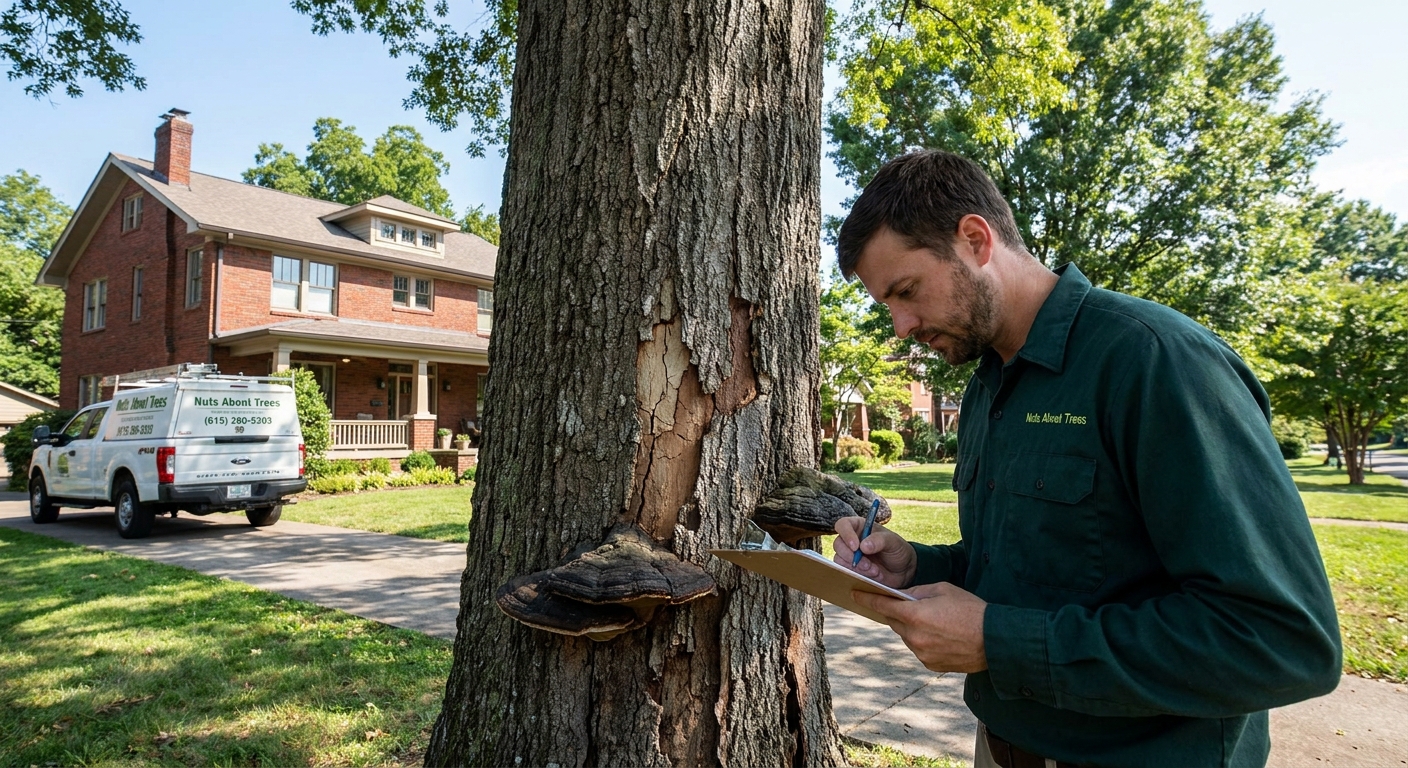
What it looks like: Bark peels off in sheets, revealing a dark brown or black crusty fungal mat underneath. It often starts on the south or west side of the trunk. Once you see it, that section is already dead. Post oaks and red oaks are hit most in Nashville, especially in Sylvan Park, Madison, and Inglewood where older oaks deal with compacted urban soil.
What to do: No treatment exists. If it’s on one branch, remove that branch. If it’s on the trunk, the tree needs to come down. Prevention means keeping oaks healthy, water during droughts, avoid soil compaction over the root zone, and protect trunks from mower and construction damage.
5. Armillaria Root Rot
Armillaria is the silent killer. By the time you see symptoms above ground, the root system is already severely compromised.
The fungus Armillaria mellea spreads through soil and attacks roots and the trunk base, rotting wood from the inside out. All oak species are susceptible.
What it looks like: Gradual canopy decline, smaller leaves, thinner growth, branch dieback at the tips. The telling sign is at the base: peel back the bark at the soil line and you’ll find white, fan-shaped fungal mats with a distinct mushroom smell. In fall, clusters of honey-colored mushrooms may appear at the base. Davidson County’s clay soil stays wet, which Armillaria loves, we encounter it regularly in Donelson, Hermitage, and parts of Antioch.
What to do: No effective chemical treatment exists. If the trunk base is compromised, the tree is a fall hazard and needs professional evaluation immediately, a tree that looks fine above but has a rotted base can come down without warning. Remove infected stumps to prevent spread to neighboring trees.
6. Oak Galls
Those weird round balls, spiky bumps, and flat discs on your oak leaves and twigs? Those are galls, and they look worse than they are.
Oak galls are caused by tiny wasps that lay eggs on oak tissue. The tree grows a protective structure around the larvae. Each wasp species produces a distinctly shaped gall.
What they look like: Round “oak apple” galls are most common in Nashville. You’ll also see bullet-shaped twig galls and the dramatic horned oak gall, a woody, spiny growth that accumulates on branches over years. Most galls are cosmetic, but heavy horned or gouty oak gall infestations can cause branch dieback.
What to do: Usually nothing. For severe twig gall infestations causing dieback, pruning out affected branches during winter removes both the galls and the developing larvae.
7. Iron Chlorosis
Technically a nutrient deficiency, not a disease, but it’s so common on Nashville oaks that it belongs on this list.
Nashville’s soil tends to be alkaline (pH 7.0-8.0+), especially where limestone bedrock sits close to the surface. At high pH, iron locks up in forms roots can’t access.
What it looks like: Leaves turn yellow between the veins while veins stay green. It hits newest leaves first and is most noticeable in spring. Pin oaks are extremely sensitive, this is why experienced Nashville arborists steer homeowners toward white oaks or bur oaks instead. Common in Green Hills, parts of Brentwood, and West Nashville where the soil is thin over limestone.
What to do: Chelated iron soil applications help temporarily. Trunk injections deliver faster results lasting 2-3 years at $150-$400 per treatment. For chronic chlorosis on a pin oak in alkaline soil, the tree may never thrive there, long-term management costs may exceed the cost of removing it and planting a better-suited species.
When to Treat vs. When to Remove a Diseased Oak
Nobody wants to take down a 100-year-old tree. But sometimes removal is the right call, and waiting too long increases risk and cost.
Treatment makes sense when: the disease is in early stages, the condition is treatable (anthracnose, chlorosis, early BLS), and the tree has significant value that justifies ongoing management costs.
Removal makes sense when: structural integrity is compromised (Armillaria, advanced hypoxylon), more than 50% of the canopy is dead, the tree threatens a structure, or it poses a spreading risk to neighboring oaks (oak wilt).
We always start with an honest assessment. In 35 years of Nashville tree work, we’ve never recommended a removal that wasn’t necessary.
Protecting Your Nashville Oaks: Preventive Steps
Water during droughts. One deep soaking per week during dry July and August stretches keeps oaks strong enough to resist opportunistic diseases.
Protect the root zone. Don’t park on it, compact it, or change the grade. Nashville’s clay compacts easily and damaged roots don’t recover.
Prune in the right season. Late winter for oaks. Never April through July. Proper cuts only, no stubs, no flush cuts, no topping.
Mulch correctly. A 3-4 inch ring extending to the drip line mimics forest floor conditions. Keep mulch 6 inches from the trunk, “volcano mulching” traps moisture and promotes rot.
Get a health assessment. An annual check from a certified arborist catches problems early when they’re cheapest to manage.
Frequently Asked Questions About Oak Tree Diseases in Nashville
Can oak wilt spread to other trees in my yard?
Yes. Oak wilt spreads underground through root grafts between oaks within 50 feet of each other, and above ground through sap-feeding beetles. If one oak is confirmed with oak wilt, neighboring oaks are at risk. Trenching to sever root connections can help prevent underground spread.
Why are my oak leaves turning brown in summer?
The most common causes in Nashville are bacterial leaf scorch (brown margins with a yellow/red band), drought stress (uniform browning at leaf edges), and anthracnose (irregular brown blotches along veins). An arborist can determine the specific cause.
How much does it cost to treat a diseased oak in Nashville?
Trunk injections for BLS or oak wilt prevention typically run $200-$600 per treatment. Iron injections for chlorosis cost $150-$400. Pruning diseased branches ranges from $300-$1, 500. Annual arborist assessments start at $100-$200.
Should I remove a tree with bacterial leaf scorch?
Not necessarily, at least not immediately. BLS is a slow decline taking 5-15 years. Treatment injections can slow progression. Removal makes sense when the tree has lost more than half its canopy or when annual treatment costs exceed the tree’s remaining useful life.
Is anthracnose killing my oak tree?
Almost certainly not. Anthracnose causes dramatic spring leaf drop but rarely kills healthy oaks. The tree will produce new leaves once warm, dry weather arrives. If your oak has declining vigor alongside recurring anthracnose, underlying issues like root rot or BLS may be the real problem.
What oak species are best for Nashville yards?
White oaks and bur oaks are the most disease-resistant and best adapted to Nashville’s alkaline clay soil. They tolerate our pH without chlorosis and resist oak wilt better than red oaks. Avoid pin oaks unless your soil pH tests below 6.5.
Get Your Nashville Oaks Evaluated
If you’ve noticed leaf discoloration, bark peeling, canopy thinning, or mushrooms at the base of your oaks, don’t wait to see if it gets better on its own. Early diagnosis makes the difference between a treatment that works and a removal that could have been avoided.
New Horizon Tree Service has been diagnosing and treating tree health issues across Nashville since 1989. Our arborists know Nashville’s soils, climate, and the specific disease pressures our oaks face. We’ll give you an honest assessment and a clear plan, whether that means treatment, monitoring, or removal.
Call New Horizon Tree Service at (615) 260-5303 for a free estimate.
See our reviews and service area on Google


