
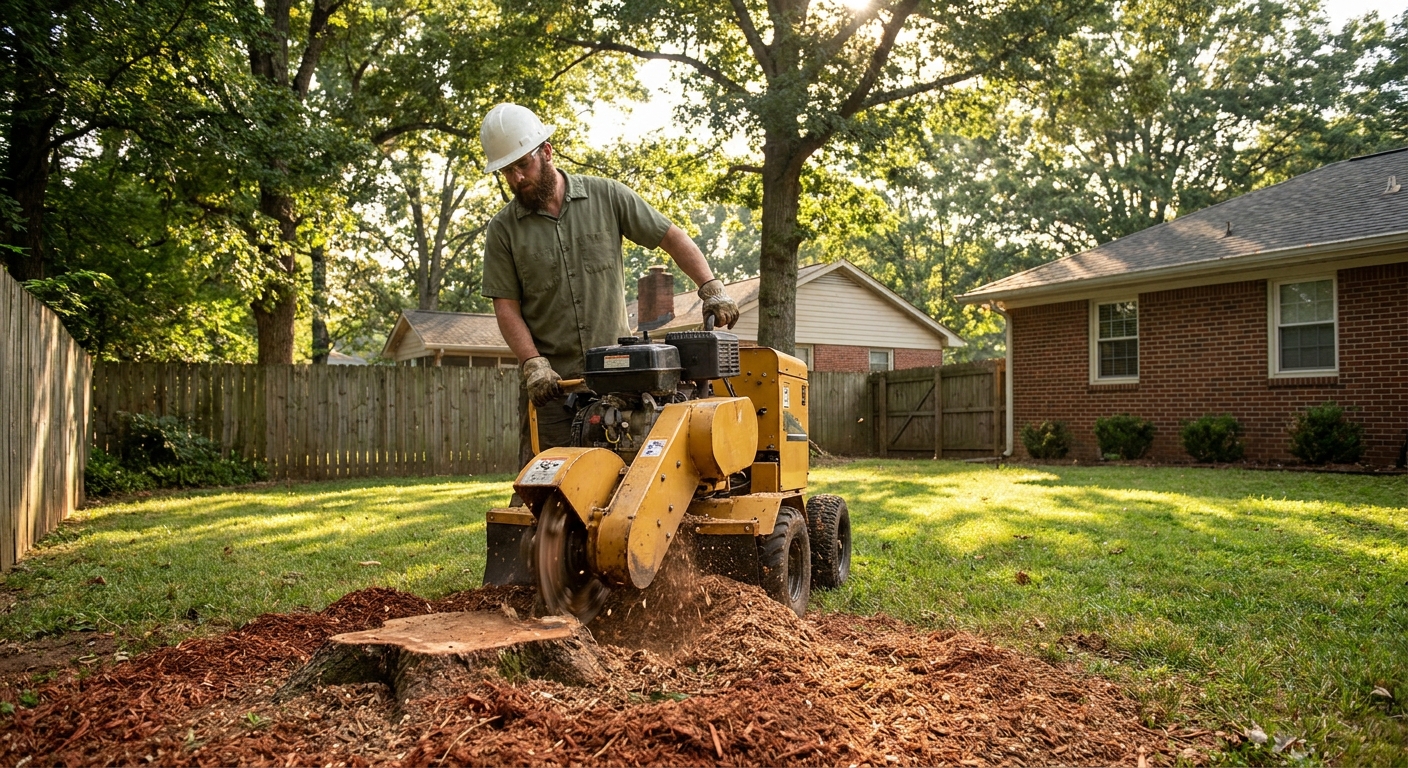
Once a tree is down, you are left with one last decision: what to do about the stump. Most homeowners assume “grinding” and “removal” are the same thing. They are not, and choosing the wrong one can cost you more money or leave you with a hole in the yard you did not expect. Here is a plain-English comparison from our Nashville tree service team so you can pick the right option for your property.
What Is Stump Grinding?
Stump grinding uses a machine with a rotating cutting wheel to chip the stump down into small wood pieces, usually 6 to 12 inches below ground level. The grinder turns the visible stump into a pile of mulch-like shavings, which can be used to backfill the hole or be hauled away. The large roots are left in the ground to decay naturally over time. It is faster, less invasive, and the most common choice. See our stump grinding service for how we handle it.
What Is Stump Removal?
Stump removal, sometimes called full stump and root removal, pulls the entire stump and the main root ball out of the ground. It is more labor intensive and usually requires heavier equipment to lift the root mass out. The result is a complete removal with no stump and no major roots left behind, but it leaves a much larger hole and significantly more disturbance to the surrounding soil and lawn. Our stump removal page covers when it is the right call.
Side by Side: The Real Differences
- Cost: Grinding is almost always cheaper. Full removal costs more because of the extra labor and equipment.
- Speed: Grinding a typical stump takes well under an hour. Full removal takes longer.
- Mess and damage: Grinding leaves a tidy patch and a fillable hole. Removal leaves a large crater and tears up more of the surrounding yard.
- What is left underground: Grinding leaves the roots to rot away slowly. Removal takes the root ball with it.
- Replanting: If you want to plant a new tree in the exact same spot, full removal makes that much easier.
When Stump Grinding Is the Right Choice
Grinding is the best fit for most homeowners. Choose it when you simply want the eyesore gone, you are reclaiming lawn space, you want to stop tripping over the stump or hitting it with the mower, and you do not plan to plant a new tree in the very same hole. It is the faster, cheaper, lower-impact option, and the leftover roots breaking down underground are rarely a problem for a lawn.
When Full Stump Removal Makes Sense
Choose full removal when the underground roots actually matter. Good reasons include: you want to replant a tree in the exact same spot, you are installing a pool, foundation, addition, or hardscape where roots would be in the way, the roots are threatening a structure or hardscape, or you are clearing a section of land entirely. If you are dealing with a whole overgrown area rather than one stump, our land clearing service may be the better path.
What About the Roots Left Behind After Grinding?
This is the most common worry, and it is usually overblown. After grinding, the remaining roots are dead, so they will not sprout new growth, and they decay quietly over a few years. They do not damage your home or attract problems in a normal lawn. The main thing to know is that as roots decompose, the soil can settle a little, so you may need to top off the spot with soil once or twice.
Can I Just Rent a Grinder and Do It Myself?
You can rent a stump grinder, but think hard before you do. These machines are heavy, throw debris at high speed, and cause serious injuries every year in inexperienced hands. Renting, hauling, and operating one often costs more in time, risk, and equipment fees than simply having a pro grind it in a single visit, especially for large stumps or several at once. For one small stump in soft ground it can be a weekend project. For anything bigger, it is not worth the risk.
Frequently Asked Questions
Is stump grinding or stump removal cheaper?
Stump grinding is almost always cheaper. It is faster, uses lighter equipment, and disturbs far less of your yard. Full stump removal costs more because pulling the entire root ball out is more labor intensive and usually needs heavier machinery.
Will the leftover roots grow back after grinding?
No. Once the tree is removed and the stump is ground out, the remaining roots are dead and will not sprout new growth. They simply decay in the ground over a few years. You may just need to add a little soil as the area settles.
Can I plant a new tree where the old stump was?
If you want to plant in the exact same spot, full stump removal is the better choice because it clears the root ball. After grinding alone, leftover roots and wood chips can make planting in the same hole harder, though you can plant nearby without an issue.
How long does stump grinding take?
A typical residential stump can be ground out in well under an hour. Larger or multiple stumps take longer, but grinding is still much faster than full root removal, and the cleanup is far simpler.
Talk to a Local Arborist
Not sure whether to grind it or pull it out completely? Call New Horizon Tree Service at (615) 260-5303 for a free, no-pressure estimate. New Horizon is a local Nashville tree service trusted from Hendersonville to Sylvan Park, fully licensed and insured, and our ISA-certified arborists are happy to take a look.


